
Safety systems in tunnels and their impact on the safety of users and rescue teams, as illustrated by the integration of three road tunnels—the S1 Węgierska Górka Bypass project and the Laliki Tunnel
Observing current trends and directions in infrastructure development, one might venture to say that “the future of transportation lies underground.” This is primarily due to limited space in cities, as well as the rapid expansion of road, rail, tram, and subway networks.
Tunnels, as specialized civil engineering structures, however, pose specific risks to both users and emergency and firefighting services. These risks stem from, among other things:
– an enclosed space with no direct access to the outdoors (except for entrances and any emergency exits),
– location beneath terrain obstacles or structures,
– lack of natural light,
– extended evacuation routes (sometimes stretching for several kilometers),
– difficult access to the scene (most often only through gateways),
– presence of internal obstacles resulting from the facility’s function (vehicles, train cars),
– high fire energy of a single incident (calculated at up to 150 MW).
It should also be emphasized that, apart from a small group of specialists, few people are familiar with the rules for evacuating tunnels—including how to behave in an emergency or where the safe zones are located. This was clearly demonstrated by the fire in the S2 tunnel in Warsaw, during which many drivers failed to follow the established procedures.
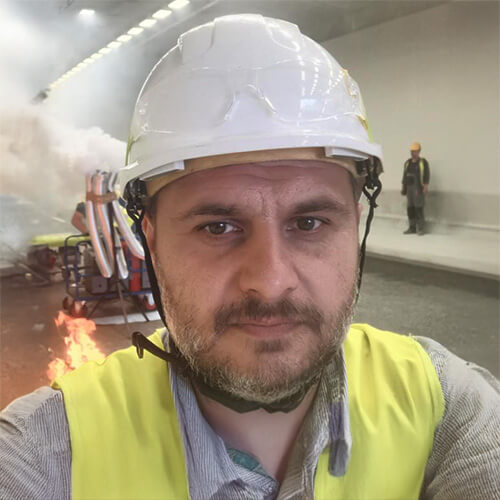
An expert with over 20 years of experience in the field of automation and fire safety systems. He specializes in solutions for critical infrastructure and high-risk industrial facilities.
He currently serves as an automation and fire safety systems specialist at WASKO S.A., where he is responsible for the design, implementation, and integration of advanced control and power supply systems for equipment used to protect lives and infrastructure.
A graduate of the AGH University of Science and Technology in Kraków (mechatronics, automation, and robotics). He also completed a postgraduate program at the Warsaw University of Technology in fire ventilation and a program in corporate quality management at AGH, combining technical expertise with knowledge of process organization and optimization.
Throughout his professional career, he has held a number of positions, including Product Development Manager at Smay Sp. z o.o., Technical Support Engineer at Multi Brands Group, and Technical Director at NEURON, where for nearly five years he was responsible for the development and oversight of technical solutions in high-risk industrial facilities.